28 October and 17 November in Prague: What's Open, What's Free, What to See
Two autumn public holidays, one on a Wednesday and one on a Tuesday, mark the founding of Czechoslovakia and the start of the Velvet Revolution. Here is what closes, what opens up, and a walking route that follows the 1989 student march through the city.
Two holidays, two very different moods
Prague has two public holidays in autumn, and they feel quite different. 28 October is Czechoslovak Independence Day. It marks the founding of Czechoslovakia in 1918 and is a formal, state occasion. 17 November is the Day of Struggle for Freedom and Democracy, which is also International Students' Day. It is more personal and more political, and it centres on Národní třída and Wenceslas Square.
In 2026, 28 October falls on a Wednesday and 17 November on a Tuesday. Many locals will take a bridge day on Monday 16 November, so expect a quieter city and busier trains out of Prague that weekend.
What's open and what's closed
28 October
This is one of the days when Czech law requires shops larger than 200 m² to close. Big supermarkets and hypermarkets, shopping-centre anchor stores and DIY chains will be shut all day. These stay open:
- Small corner shops and convenience stores (the ones under 200 m²)
- Shops at the main railway stations and the airport, plus petrol stations and pharmacies
- Restaurants, cafés, bars and most tourist attractions
Bank and post office hours vary, so check before you go. Stock up the day before if you plan to cook.
17 November
The large-shop closure law does not cover 17 November, so most supermarkets and shopping centres open, though hours vary. Schools and universities close.
Public transport
On both days, Prague's trams, metro and buses are likely to run to a holiday timetable, so services may be less frequent than on a normal weekday. On 17 November, diversions are likely around Národní třída. Check dpp.cz for diversions before you set out.
28 October: what to see
The official programme runs from morning to evening. The president and senior officials lay wreaths at the Vítkov National Memorial in Žižkov. It is the large functionalist monument with the equestrian statue of Jan Žižka and the Tomb of the Unknown Soldier. In the evening, the president presents state decorations at Prague Castle.
For visitors, the attraction is usually access. In past years the National Museum has marked the day with free or reduced entry, which includes Vítkov, run as one of its branches. Prague Castle and some government buildings have also opened areas that are normally closed. These offers are announced only a few weeks ahead, so watch nm.cz and prague.eu in October. Expect queues at anything free and arrive early.
Independence was declared in Prague in 1918. The Municipal House (Obecní dům) by Náměstí Republiky is an Art Nouveau building worth a look on any day. The street 28. října, which links Národní třída to the bottom of Wenceslas Square, is named after the date.
17 November: what to see
The date commemorates two events, fifty years apart. On 17 November 1939, Nazi authorities closed Czech universities after student protests. They executed nine student leaders and sent more than a thousand students to concentration camps. On 17 November 1989, a student march held to mark the 50th anniversary was broken up by riot police on Národní třída. That set off the Velvet Revolution, and within six weeks Václav Havel was president.
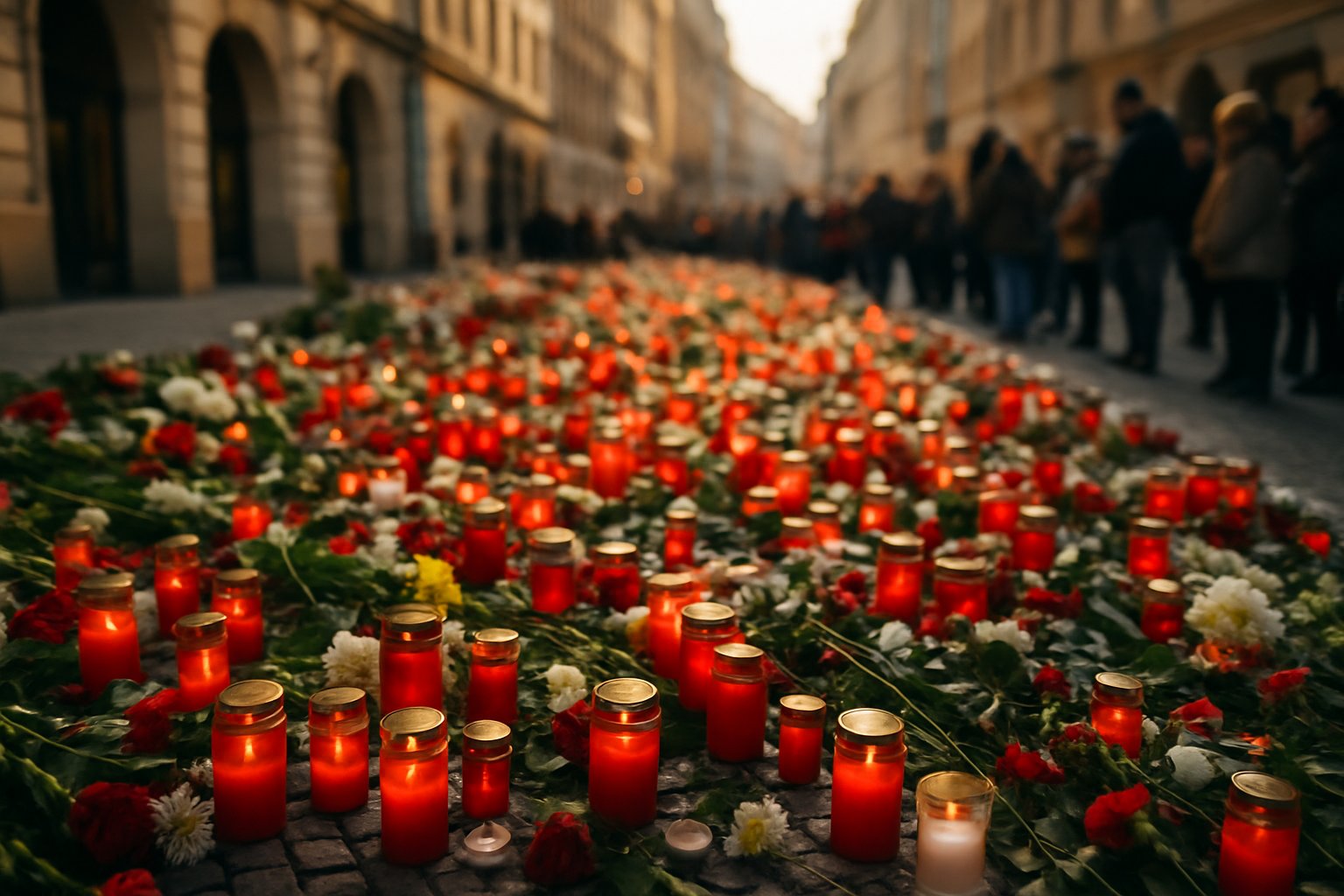
The focus of the day is the memorial plaque at Národní 16. It is a bronze relief of raised hands, several making the V for victory sign. People leave candles and flowers here from early morning, and by evening the pavement is a field of light. It is moving to see and gets very crowded after dark.
In past years Národní třída has been closed to traffic for the day, and students have turned it into a pedestrian festival with stages, talks, music and stalls, under the name Korzo Národní. Wenceslas Square has also hosted concerts or gatherings in the evening, and student groups have held a commemoration at Albertov. Check with the organisers for what is planned in 2026. The tone is part remembrance, part celebration, and often part protest. It is safe and family-friendly, but it is busy.
Walking route: Albertov to Národní to Wenceslas Square
This route roughly follows the 1989 march. It takes a few hours with stops. You can walk it on the day itself or any time in autumn.
- Albertov. Start among the Charles University science and medical faculty buildings, where the students gathered on the afternoon of 17 November 1989. A plaque marks both 1939 and 1989. The nearest metro is Karlovo náměstí (line B), or take a tram to the Albertov stop.
- Vyšehrad. Walk uphill to the Vyšehrad fortress and its cemetery. The marchers went to the grave of the Romantic poet Karel Hynek Mácha, a traditional student pilgrimage site. Slavín, the pantheon tomb of Czech cultural figures, is next to it.
- The embankment. Head down to the Vltava and follow the riverside north past the Dancing House toward the National Theatre. This is the longest stretch, and the same way the crowd walked as dusk fell.
- Národní třída. Turn right at the National Theatre onto Národní. Walk to No. 16, where police blocked the crowd from front and back and beat the people they had trapped. Stop at the plaque.
- Wenceslas Square. Continue along 28. října and Na Můstku to the bottom of the square. In the days after 17 November, hundreds of thousands of people filled it. Halfway up on the left, the balcony of the former Melantrich building at No. 36 is where Havel and Alexander Dubček addressed the crowds. Finish at the top by the St Wenceslas statue. Just in front of the National Museum, a bronze cross set into the pavement remembers Jan Palach and Jan Zajíc, the students who set themselves on fire in protest in 1969.
If you want more, the Memorial to the Victims of Communism is across the river at the foot of Petřín in Malá Strana. Its bronze figures fade away as they descend the steps. The tram ride from Národní třída to the Újezd stop is short.
Practical tips
- Bring a candle in a glass holder if you want to join the tribute at Národní 16. Convenience stores nearby sell out by evening.
- Book restaurants near Národní and Wenceslas Square for the evening of 17 November. They fill quickly.
- On 28 October, do your grocery shopping the day before or use the shops at Hlavní nádraží station.
- Dress for a cold, damp evening. Most of the 17 November programme happens outdoors after dark.
The 2026 programmes, free-entry offers and opening hours have not yet been confirmed and change from year to year. Check before you go on prague.eu, nm.cz and dpp.cz.
Leave a Reply